
This winter, we’ve been hard at work building new projects, tools, and features to save our customers money and unlock more value across the board. Now as we turn toward spring, we're excited to announce our 2026 MEI+ Summit, a new way for our customers to measure savings on our Madi portal, and an upcoming policy roundtable event at our MEI+ Lab in New York.
MEI+ is how Madison connects with leading organizations to tackle the challenges of today’s New Normal and deliver the economic and reliability benefits of clean energy. What we're building goes beyond efficiency — it's about bringing the right capital, technology, and expertise together to create something that lasts for decades.
.gif)
Last year's inaugural MEI+ Summit was something special. Strong conversations, the debut of a new digital product, and the public launch of the MEI+ lab – all in one room with the people who are moving clean energy infrastructure forward. We left energized, and we've spent the past year thinking about how to build on it.
June 16th is the answer. Same spirit, larger room, and an agenda built around the conversations that matter most right now – with the clients, partners, investors, and policy makers who are doing the real work of shaping what's next.
We'd love to have you there. Space is limited so if you're interested, let us know early.
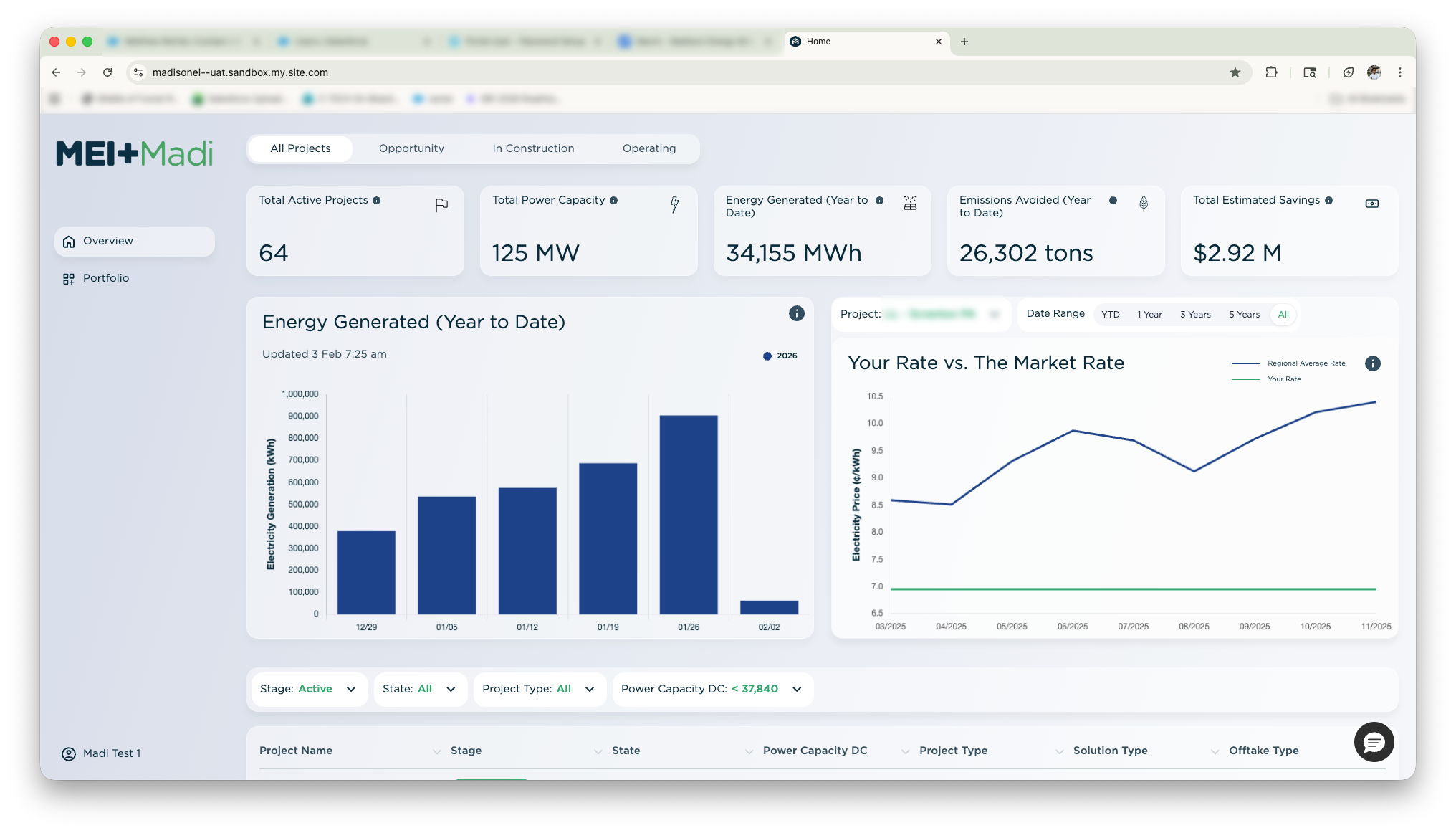
We've added something to the Madi customer portal that we think you'll appreciate: a clear, real-time view of exactly what you're saving with Madison. Your actual bill, measured against what you'd pay at market rates — updated continuously, no estimates involved. We've always believed in showing our work, and this is that commitment made visible.
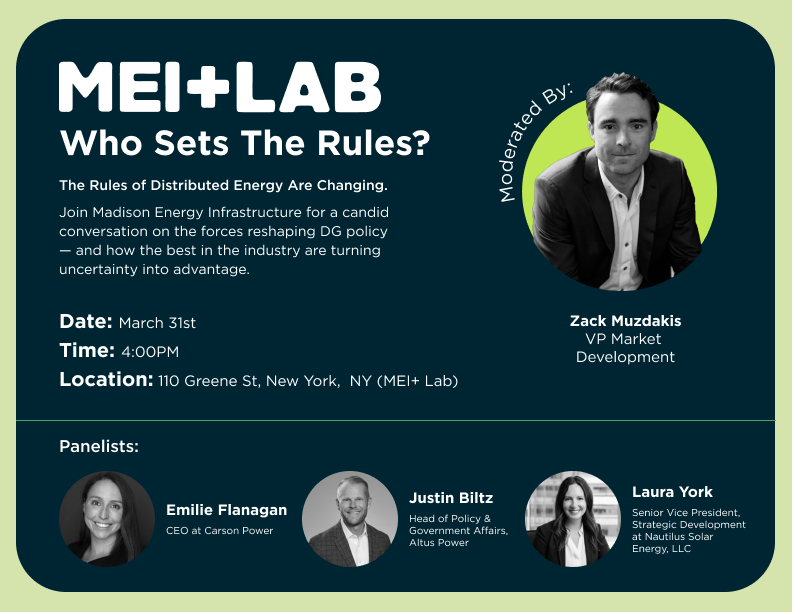
The rules are changing. Let’s talk about it.
The most effective players aren't sitting back waiting for clarity—they're turning uncertainty into an advantage. Join Emilie Flanagan (CEO, Carson Power), Laura York (SVP of Strategic Development, Nautilus Solar Energy), and Justin Biltz (Head of Policy & Government Affairs, Altus Power) for an honest conversation about who's writing the rules, who's rewriting them, and how to position yourself for what comes next. Moderated by Zack Muzdakis, VP of Market Development at Madison Energy Infrastructure.
Battery storage is stepping into a starring role. With costs falling to about $65/MWh and Europe projected to need 200 GW of storage by 2030, batteries are transforming from grid add-ons into essential infrastructure, unlocking round-the-clock clean power and strengthening grid reliability.
.png)
AI-driven data centers are fueling a massive grid buildout, with U.S. utilities facing a potential $1.4 trillion investment cycle through 2030. But rising metal costs and uncertain demand could complicate cost recovery, prompting regulators to push for large energy users to shoulder more of the expense.
This month marks a key movement in clean energy in Illinois, Virginia, and Missouri.

Illinois is advancing HB 5607, the Advanced Technology Leadership Act, requiring large data centers to match their electricity use with renewable energy credits starting in 2027, with hourly clean-energy matching by 2030, a policy that could boost REC demand and accelerate new renewable projects statewide.


Facing surging electricity demand driven in part by data centers, Virginia lawmakers are advancing a portfolio of energy policies, from storage and solar to improved grid use, to boost capacity and reliability. The strategy highlights the growing role of distributed energy resources in meeting demand quickly and cost-effectively.
.png)
Missouri lawmakers have introduced HB 662 and SB 386 to launch a three-year community solar pilot, expanding access to locally generated solar power. The program would allow residents and businesses subscribe to solar projects and receive bill credits, opening the door to affordable clean energy without rooftop installation.

Henry A. Kissinger, Eric Schmidt, and Daniel Huttenlocher
This book explores how artificial intelligence is transforming society, from reshaping jobs and creativity to influencing medicine, security, and decision-making. As AI advances faster than our ability to fully understand or control it, it raises critical questions about trust, knowledge, and governance. The result is a timely look at how this technology is redefining our world and what it means for the future.