Small Advantages. Big Wins.
Download resource
Small Advantages. Big Wins.
%2520(1).gif)
Our Chief Revenue Officer, Cameron Bard, recently published an op-ed in Solar Power World emphasizing our vision to build a dynamic ecosystem where capital, technology, and—crucially—policy come together to modernize energy for industry and communities where it matters most.
This past month, that vision met reality: a school district locking in 25 years of cost savings, AI turning field data into faster O&M decisions, and the MEI+ Summit agenda taking shape with executives from Anthropic, Salesforce, NextEra, and more.
To round it out, CEO Richard Walsh writes on the compounding principle and why the companies that succeed over the long term are the ones building small advantages that add up to big wins.
Read on.

Every dollar a school district spends on energy is a dollar not spent on students. Charlottesville City Schools knew that – and came to Madison looking for a better answer.
The result: a 25-year solar PPA powering nearly two thirds of the school's electricity needs. The 1.3 MW system is expected to generate 1.7 million kWh annually and deliver approximately $2.3 million in savings over the life of the contract. Not a rounding error. Real budget relief, reinvested in the community.

In his latest piece, Cameron Bard argues that clean energy has both a messaging and organizing problem—one shaped by years of underinvestment in our political processes and the errant prioritization of short-term incentives over long-term infrastructure and the pursuit of self-sustaining markets.
At a moment when the stakes are rising, the industry is still too often on the sidelines.
The path forward isn’t subtle: compete more effectively, engage more directly, and communicate value in terms that resonate beyond the industry itself.

A recent study finds that about 90% of U.S. wind and solar projects reviewed under state-level permitting were approved, with most decisions reached in roughly one year. Approval rates and timelines vary by state, highlighting how permitting structures influence renewable energy deployment speed and project outcomes.
This month marks a key movement in clean energy in Nevada, New York, and Minnesota.

Nevada regulators approved NV Energy’s plan to join CAISO’s Extended Day-Ahead Market, a move expected to lower costs, expand access to diverse regional resources, and improve grid reliability. The decision
positions Nevada as a key hub in the evolving Western electricity market.


New York’s Value of Distributed Energy Resources proceeding continues to reshape how solar assets are valued. Ongoing
updates to marginal cost methodologies aim to better capture distribution savings, creating opportunities to drive greater value to the grid and communities.
Minnesota regulators approved Xcel Energy’s plan to build a utility-owned virtual power plant using up to 200 MW of distributed batteries. Supporters say it could boost grid reliability, while critics warn it may limit competition from third-party developers and
reshape future DER market structures.

We’re back for our second annual MEI+ Summit, and round two is shaping up to be our biggest and best yet.
Confirmed participants for this year’s event include executives from Anthropic, Salesforce, EQT, NextEra, Avangrid, ComEd, and more. The agenda centers on the intersection of infrastructure and strategy where capital is moving, how risk is being priced, and what defines competitive advantage in an uncertain environment.
Our MEI+ Summit brings together leaders across energy, technology, and finance for a focused day of interactive discussions (and a live recorded podcast!) on what’s actually driving decisions in today’s market.
Applications are open, with limited capacity.
Explore the agenda and speakers.

At Solar Plaza, our VP of Asset Management, Matt Messer, led a discussion on how and where AI is delivering tangible improvements in solar O&M. The focus wasn’t theoretical – it was operational: better data, faster response times, and more consistent performance across portfolios.
At Madison, this approach is already in practice. Expanded regional coverage and integrated systems are enabling our teams to identify and address performance risks earlier—pairing experienced operators with tools that enhance, rather than replace, decision-making.
The result is straightforward: stronger asset performance and better outcomes for customers.

Twice a year our leadership team gets together to align on strategy, spend some quality time together outdoors, and nerd out on a book. This one spoke directly to how we think about the long term and our motto of “small advantages, BIG WINS." Take a look at what we learned from some of the most impressive companies you've probably never heard of.
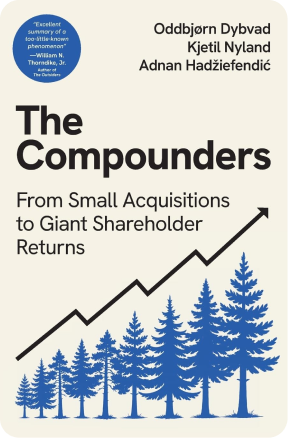
Oddbjørn Dybvad, Kjetil Nyland, Adnan Hadžiefendic
The Compounders reveals nine overlooked publicly traded conglomerates from around the world, united by a common vision of top-tier value creation—and explores in depth how these companies consistently outperform industry giants like Berkshire Hathaway and major stock market indexes. Discover the strategies, learn from the success stories, and unlock the secrets of investing in acquisition-driven compounders where diversity, resilience and scale come together to produce unmatched financial success.