The AI Imperative at the MEI+ Summit 2026
Download resource
The AI Imperative at the MEI+ Summit 2026
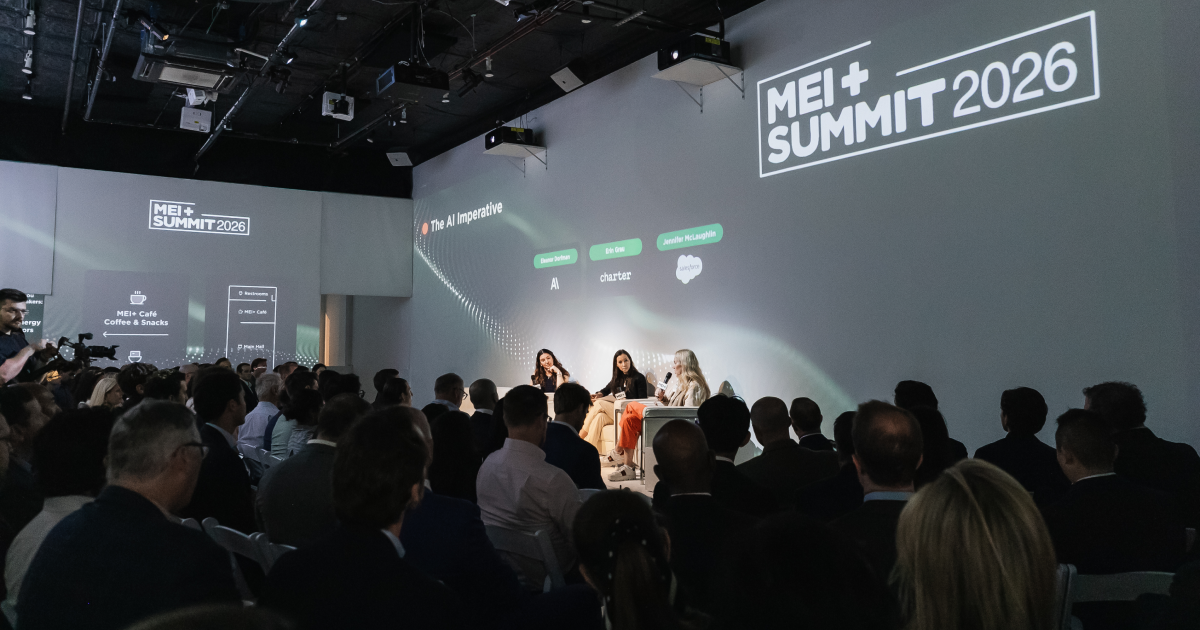
Every company is racing to figure out what AI actually means for how it operates. At this year's MEI+Summit, Madison brought together leaders who are living that question from opposite sides of the table: one selling the technology to the world's largest enterprises, and one rebuilding a thousand-person organization around it.
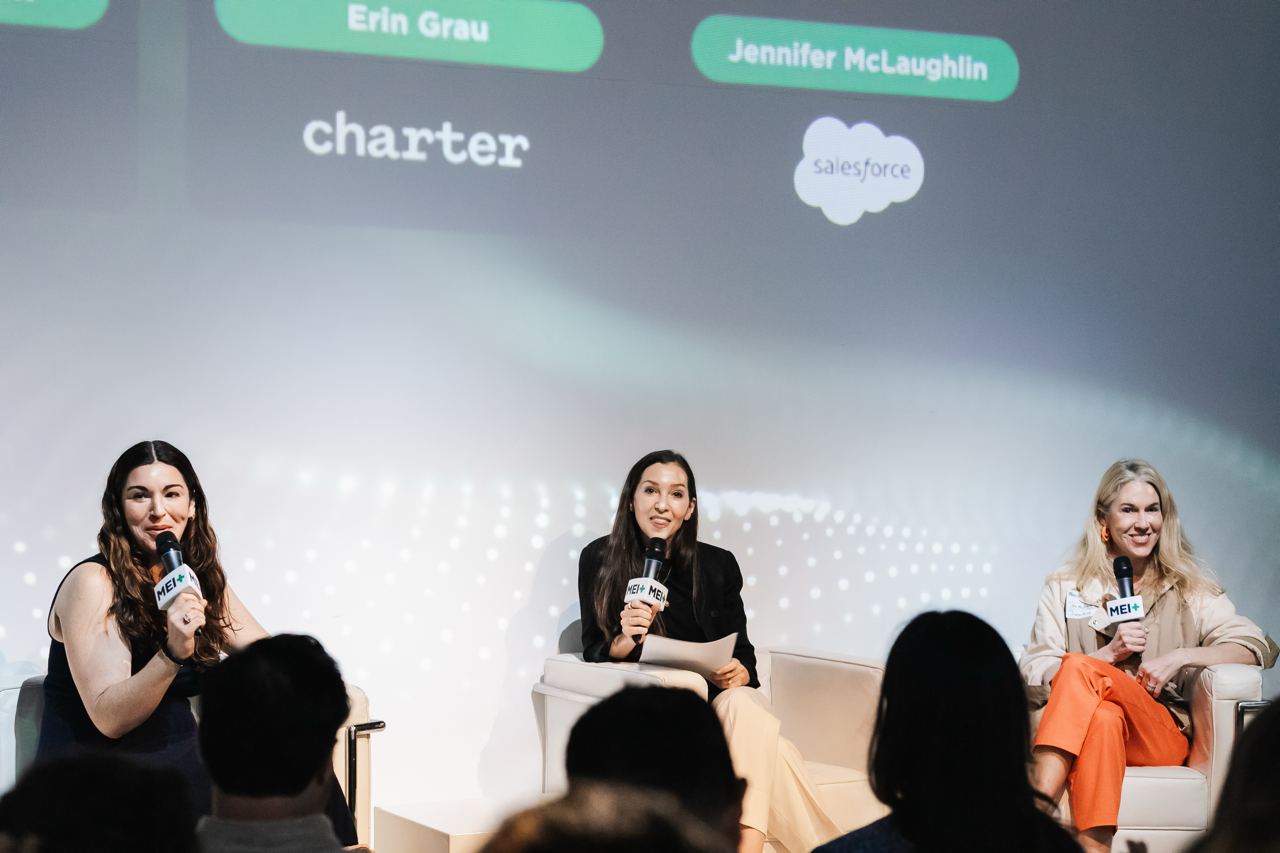
Now in its second year, the MEI+ Summit has become a gathering point for the people shaping the future of energy, infrastructure, and capital — and this year, that conversation expanded to include the technology reshaping how every one of those industries gets work done. The AI Imperative panel brought together Eleanor Dorfman, Head of Commercial Sales and Private Equity at Anthropic, and Jennifer McLaughlin, EVP of Data Foundations Solutions Engineering at Salesforce, for a candid conversation about what it actually looks like when AI moves from experiment to infrastructure inside a major organization, moderated by Erin Grau, Chief Operating & AI Officer at The San Francisco Standard and Co-founder of Charter.
Opening the session, Grau didn't waste time. The goal was to move beyond which tools people use and talk about what actually changes in how leaders lead, how teams are built, and how problems get solved once AI stops being a sidebar and becomes the operating system.
From Productivity to “Super Intelligence"
Grau pushed the panelists past their tech stacks early on, toward a framework Anthropic uses to talk about where AI actually creates value. “We talk a lot about productivity, but where is the value creation?" she asked. “Can you share with us how you think about this?"
Dorfman answered by reframing how Anthropic talks about AI's value internally and how she coaches her own sales team to talk about it with customers.
“We're not selling productivity, we're selling super intelligence," she said. “It's just this mindset shift that's very hard to make. You sort of just have to sit with it for a while."
To make that shift concrete, Dorfman walked through the framework Anthropic uses with enterprise customers. The "Claude thinking engine" is built around three pillars: make your employees better, make your processes better, and make your products better. She pointed to Goldman Sachs rebuilding its KYC onboarding process end-to-end, and to Slack embedding Claude directly into its product, as examples spanning all three.
McLaughlin offered the view from inside a thousand-person organization undergoing that same shift. The old way of making decisions, she explained, required gathering data from disconnected systems before anyone could even start. Now, embedding AI directly into the flow of work removes that friction which frees people up for the part of the job that actually matters.
“It's not just about, can I make my employees 20 to 40% more productive so they can spend more time with their clients," McLaughlin said. “It's actually: what can they start doing differently? That's what's really exciting when I talk to customers."
Delegation, Not Just Conversation
One of the most striking moments of the panel came when Dorfman described the shift from using AI to answer questions to using it to own entire workflows.
While testing a new org structure for her own team, Dorfman said she didn't want to pull her operations team into a time-consuming exploratory exercise, so she handed the entire project to Claude instead.
“I had Claude Cowork run an analysis of, if it were designing my work from scratch, what competencies would it use," she said. "Build the competencies. Run every account against those competencies. Score every account. Run every account against location. Build a territory. Run that against the sales team and what they've historically been good at. Assign the territory. I delegated what was probably a million-dollar McKinsey project to Claude to work on while I showered and got ready for the rest of the day." Treating AI as something you delegate to, not just something you ask questions of came up repeatedly as the moment that tends to change how people think about the technology entirely.
Dorfman encouraged the audience to connect a data source, build a simple skill, and then hand off a real task end to end. “It's a mind-blowing moment the first time you realize: I am just scratching the surface of what this is capable of."
Listening to Dorfman describe how her team operates, Grau offered the line that became something of a thesis for the whole panel: “AI is shrinking the distance between the problem and the solution.”
Later, asked how leaders can cultivate that kind of grassroots momentum beyond their own teams, Dorfman shared a story from her own pipeline that captured the same idea at the individual level. She'd noticed one of her best reps had stopped relying so heavily on technical support, not because he needed less help, but because he'd found a faster way to get it himself.
“I just do really good discovery. I take the Gong transcript, I drop it into Claude Code, and it builds a prototype I can use to get a little bit further before I have to pull in a sales engineer," the rep told her, in Dorfman's retelling. “This makes so much sense," she said.
What Separates Successful Adoption From Stalled Pilots
Both panelists were direct about where AI initiatives tend to break down. For McLaughlin, it almost always traces back to data and ownership.
“There's a fundamental data problem that we all have at organizations, where data is fragmented, siloed. Is it governed, is it mastered?" she said. She described visiting a large building-supply customer in France where the integration team, the AI center of excellence, and the data team barely spoke to one another. “I felt like we were trying to matchmake on the spot."
Her advice for any organization serious about scaling AI: get an executive sponsor in place early, and make sure someone is actually accountable for putting their name behind a use case. “You need to have somebody at your company who uses the technology every day, who is invested in that particular use case being successful, and who can put their name behind it," she said. “That's really important in terms of getting agentic initiatives into production instead of just in a sandbox."
Dorfman pointed to a related but distinct failure mode: chasing AI for its own sake rather than starting from a real business problem. Her advice was to find the people on a team who are closest to the problem and give them room to experiment.
“It's identifying who on your team is closest to the problems, because what you can do is unlock their ability to solve their problems," she said. “Give them some token budget, let them experiment. Your best ideas are going to come from across the organization."
Culture Is the Real Infrastructure
“What advice do you have for leaders in the room who are managing people and also AI and tech?" Grau asked partway through the panel. “What has changed for you as a leader in the past few years?"
A recurring theme of the answers was that the hardest part of AI adoption isn't technical, it's cultural. McLaughlin described building “power hours" across time zones where individual contributors and leaders separately demo what they've built, modeled on lessons Salesforce learned the first time it rolled out Slack company-wide without enough structure.
“What I'm trying to do is inspire, create a culture of experimentation with some guardrails," she said. She described checking a usage dashboard and finding an employee who had used 86 million tokens building an unsanctioned but genuinely useful internal tool. The lesson wasn't to shut it down, she said, but to surface it “so people don't duplicate effort," spending hours independently rebuilding the same thing five different teams already needed.
Dorfman agreed, adding that visible support from senior leadership changes how willing people are to take the risk of experimenting in the first place. “Experimentation hasn't necessarily always been something you reward in corporate culture, and I think a lot of people right now are afraid to get it wrong," she said. “An important thing from the top down is to foster the fearlessness, to foster the creativity. The cultural shift is just as important as getting people access to the technology."
The “Aha” Moment
Asked what a genuine breakthrough moment with AI tends to look like, Dorfman returned to where she'd started: the leap from asking a question to delegating a task. She recounted a friend's husband who, in a time crunch, asked Claude to build a financial model in Excel and was so struck by the result that he had to step away from his desk.
“He texted me after and said, 'Well, that was some witchcraft.'" she said, laughing. “Make a skill, delegate a task, and then sit with it. You have to push yourself out of your comfort zone and delegate something end to end to really have the moment."
It was a fitting close to a conversation that, throughout MEI+ Summit's second year, kept circling back to the idea Grau had named earlier in the session: AI's real power isn't productivity, it's shrinking the distance between a problem and its solution. The organizations getting the most out of it aren't the ones with the most tools, they're the ones willing to hand over real work, build the trust to do it again, and let that confidence compound.